
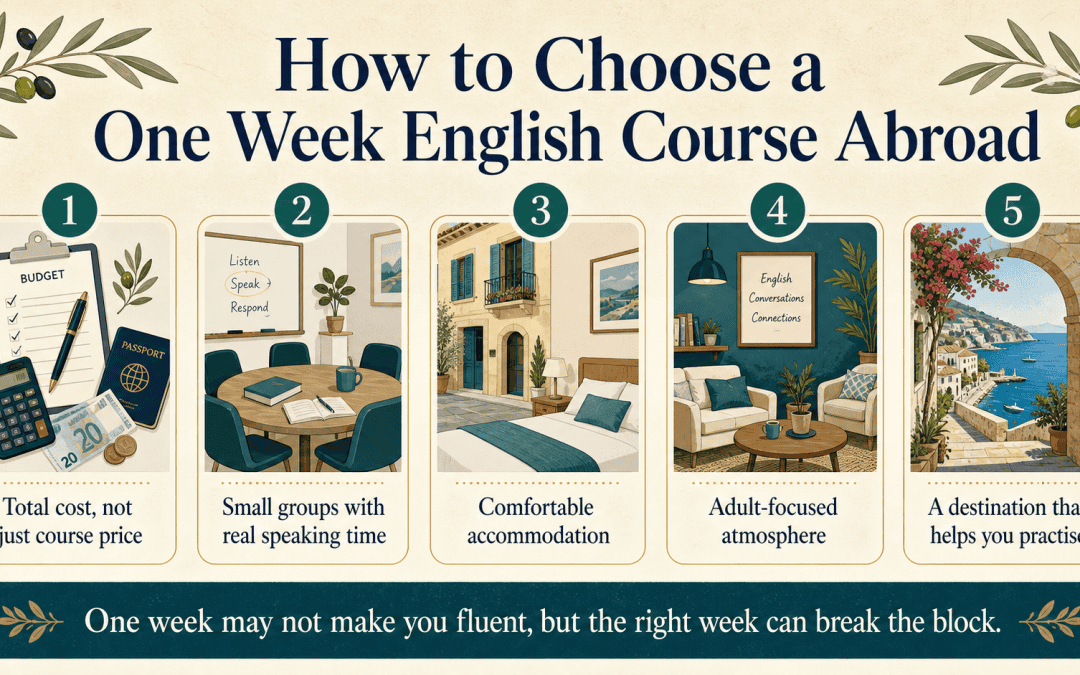
Choosing a one-week English course abroad sounds simple at first.
You choose a destination, compare a few prices, check the dates, book the course, and go. Done.
Except it is not always that simple.
A one-week English course can be a fantastic experience, especially for adults who want to reconnect with English, improve confidence, travel somewhere beautiful and finally use the language in real situations. But it can also be disappointing if you choose the wrong format.
The problem is that many people compare courses too quickly. They look at the price of the lessons and think they are comparing like for like. But they are not.
One course may include only classroom hours. Another may include accommodation. Another may include taxes, registration fees, materials or activities. Another may look cheap at first, but once you add accommodation, transport, meals, supplements and local expenses, the final cost is much higher than expected.
And price is only one part of it.
The real question is not simply, “How much does the course cost?”
The better question is: “What kind of week am I actually going to have?”
Because if you only have one week, every detail matters.
Is one week enough to improve your English?
Let’s be honest: one week is not enough to completely transform your English.
If someone promises that you will become fluent in five days, be careful. Real fluency takes time, repetition, exposure, correction and practice. For most adult learners, two weeks is usually better than one, and longer stays can obviously create more progress.
But one week can still be very useful.
A good one-week English course abroad can help you break the block that stops you speaking. It can help you reactivate English you already know. It can give you confidence, rhythm and a clearer sense of what you need to work on next. It can also remind you that English is not just something you study, but something you use to connect with people.
That is often the biggest change.
Many adults arrive thinking their English is worse than it really is. They have studied grammar. They understand more than they can say. They may use English at work, when travelling or when watching films, but speaking still feels uncomfortable.
After a few days of real conversation, something changes. They stop trying to build every sentence perfectly before speaking. They start communicating. They make mistakes, of course, but they also realise they can be understood.
That shift can happen in one week.
Not full fluency.
But a real breakthrough.
First, be clear about what you want from the week
Before comparing destinations or prices, ask yourself why you want to do the course.
- Do you want to speak more confidently when travelling?
- Do you need English for work?
- Do you want to stop freezing in conversation?
- Do you want a holiday with purpose?
- Do you want structured learning without feeling like you are back in a classroom?
- Do you want to meet interesting people and use English naturally?
Your answer matters because not every English course abroad is designed for the same person.
Some programmes are better for teenagers. Some are designed for university students. Some focus on exam preparation. Some are very social and nightlife-oriented. Some are large and busy. Some are more academic. Some are better for adults who want a calm, personal and focused experience.
If you are an adult between 30 and 60, a professional, or someone who wants to enjoy a meaningful holiday while improving English, you probably do not want the same experience as a 17-year-old on a summer programme.
That does not mean the course should be boring. Far from it.
It means the atmosphere should fit you.
You may want good conversation, comfortable accommodation, small groups, proper teacher attention, cultural activities, time to relax, and people you actually enjoy speaking with.
That is very different from choosing the cheapest course in the busiest destination and hoping it works.
Do not compare only the course price
This is probably the most common mistake.
People often compare English courses abroad by looking at the weekly lesson price. But that number alone tells you very little.
You need to understand the total cost of the experience.
- Does the price include accommodation?
- Are taxes included?
- Are registration fees included?
- Are materials included?
- Are there extra charges for placement tests, certificates or administration?
- Do you have access to a kitchen?
- Will you need to eat every meal out?
- How far is the accommodation from the lessons?
- Will you need daily transport?
- Are activities included or optional?
- Are airport transfers available?
- Are you staying somewhere comfortable, or will you need to upgrade?
This is where a cheap course can become expensive very quickly.
For example, a course might look affordable, but if accommodation is separate, breakfast is not included, the room is far away, the area is expensive, and every activity costs extra, your real weekly cost may be much higher than expected.
On the other hand, a course that looks more expensive at first may actually be better value if accommodation, taxes, access to common areas, kitchen use, support and a more personal experience are included.
So, when you compare options, do not ask only: “What is the course price?”
Ask: “What will this week actually cost me, and what am I really getting?”
Group size matters more than most people think
If your main goal is to speak English, group size is crucial.
In a large group, your speaking time is limited. You may listen, take notes and complete activities, but how many minutes will you actually speak? How often will the teacher hear you properly? How much feedback will you receive? How easy will it be to ask questions?
For a one-week course, this matters even more because time is short.
You cannot afford to spend five days hiding at the back of a large room.
A good one-week English course should give you regular speaking time every day. Not just pair work for two minutes. Not just repeating sentences. Real speaking.
You should be explaining ideas, asking questions, reacting, telling stories, discussing topics, making mistakes and receiving correction.
This is why small groups are so powerful.
In a small group, you cannot disappear, but you also do not feel exposed in the same way as in one-to-one lessons. You have other people to interact with, but still enough attention from the teacher. You can build trust, learn from others and speak much more.
If you only have one week, small groups are not a luxury.
They are one of the main things that make the week useful.
Check how many real hours you will get
Many courses advertise 20 lessons per week, but a “lesson” may not be a full hour.
Sometimes a lesson is 45 minutes. Sometimes 50. Sometimes the schedule includes breaks that make the week feel shorter than expected.
This is not necessarily wrong, but you should know what you are booking.
For a one-week English course abroad, around 20 real hours of focused learning can be a very good format for adults. It gives you enough structure and intensity without exhausting you completely.
More is not always better.
If you do seven hours of lessons a day but feel mentally destroyed by Wednesday, the quality of learning may drop. Adult learners need energy for conversation, activities, social interaction and reflection. Some of the best learning happens outside the formal lesson, especially when the environment encourages English naturally.
Ask these questions before booking.
- How many actual hours are included?
- How much of that time will I spend speaking?
- Will the course be adapted to my level and needs?
- Will I get feedback?
- Will there be time to practise outside formal lessons?
The number of hours matters, but the quality of those hours matters more.
Twenty real hours with a lot of speaking in a small group can be far more useful than a larger number of passive hours in a crowded room.
Accommodation is part of the learning experience
When you choose an English course abroad, accommodation is not just a place to sleep.
It affects your comfort, your budget, your energy and your opportunities to use English.
If your accommodation is stressful, noisy, far away or uncomfortable, it will affect the whole week. If you have to spend time organising transport, finding meals and solving practical problems, that is energy you are not using for learning.
For adult learners, comfort matters.
You do not need luxury, but you do need a place where you can rest properly, feel safe, prepare simple food if you want to, and enjoy common spaces where conversation can happen naturally.
The best accommodation for a one-week English course is not only convenient. It creates opportunities.
- Can you speak with other learners?
- Can you have breakfast with people?
- Can you use the kitchen?
- Can you sit in a shared area and continue a conversation after class?
- Can you feel at home rather than like you are just passing through?
This is especially important for adults who want a language holiday rather than a purely academic course. The environment should support the learning, not sit separately from it.
A week is short. If your accommodation and learning space work together, the experience becomes much richer.
Think about the people you will practise with
English is not improved only through lessons. It improves through people.
That is why the social environment matters.
Who will you speak with during the week? Are they likely to be adults with similar goals? Will they want to practise English? Will they be there for learning, relaxation, conversation and cultural experience, or mainly for partying?
There is nothing wrong with nightlife if that is what someone wants. But if your goal is a focused adult English course, you probably want a different atmosphere.
You want people who are friendly, curious and open to conversation. You want other learners who understand that mistakes are normal. You want teachers who help people connect. You want an environment where speaking English feels natural, not forced.
In one week, the right group can make a huge difference.
A good group gives you confidence. A mismatched group can make the week feel awkward or less useful.
So look for courses that are clear about who they are for.
If a course says it is for everyone, from teenagers to retirees, beginners to advanced learners, party travellers to professionals, ask yourself whether it is really designed for you.
Choose a destination that supports your goal
The destination matters, but not always in the way people think.
A famous city may sound exciting, but it can also be expensive, noisy and distracting. A very busy destination may offer lots of entertainment, but not necessarily the calm or focus you need. A remote place may be beautiful, but if there is nothing to do or nobody to speak with, the week may feel limited.
For a one-week English course abroad, the best destination is one that helps you use English and enjoy the experience without overwhelming you.
You want enough to do, but not so much that the course becomes secondary.
You want beauty, comfort and culture.
You want opportunities for conversation.
You want to feel that the week is special.
This is one of the reasons Malta and Gozo can work so well for adult English learners. English is widely used, the Mediterranean setting is beautiful, and the experience can combine learning with travel, culture, sea, food, activities and rest.
Gozo, in particular, offers something quieter and more personal. It is not the right choice for someone looking for big-city nightlife. But for adults who want a meaningful English-learning holiday, it can be ideal.
Make sure the course is personalised
A one-week course should not feel generic.
If you only have a few days, the teacher needs to understand quickly what you need. Are you blocked when speaking? Do you translate too much? Do you need vocabulary for work? Do you struggle with pronunciation? Do you need to build confidence? Do you need correction? Do you need fluency practice?
Personalisation does not mean every second of the course is private or improvised. It means the course responds to the learners in the room.
A good teacher should adapt topics, correction, speaking tasks and feedback to the group. They should notice what is stopping you and help you move forward.
This is especially important for adult learners, because adults arrive with very different histories.
Some have studied English for years but cannot speak.
Some use English at work but feel insecure.
Some understand a lot but freeze in conversation.
Some have not studied for decades.
Some want travel English.
Some want professional communication.
A one-size-fits-all course cannot serve all of them properly.
Activities should create real communication
Activities are not just entertainment.
They can be part of the learning.
When you go for a walk, visit a place, cook together, have breakfast, try an activity or explore a new area, English becomes more natural. You are no longer speaking because an exercise tells you to speak. You are speaking because you have something to say.
That is a very different type of practice.
For adult learners, this can be especially powerful because it feels less artificial. You talk about what you see, what you think, what you like, what surprises you, what you remember and what you want to do next.
This is why the best one-week English courses abroad do not separate “learning” and “experience” too much.
The formal lessons matter, but so do the conversations around them.
The coffee after class.
The breakfast conversation.
The walk through a village.
The activity where you suddenly need to ask a question.
The moment when you realise you have been speaking English for twenty minutes without thinking too much about it.
That is where confidence grows.
This practical emphasis reflects an action-oriented approach to language learning and the value of target-language use outside class.
What should a good one-week English course include?
A strong one-week English course abroad for adults should include much more than lessons.
- A clear adult focus
- Small groups
- A lot of real speaking time
- Comfortable accommodation or clear accommodation support
- Transparent pricing
- No surprise fees
- A teacher who gives personal attention
- A relaxed but purposeful atmosphere
- Opportunities to use English outside the lesson
- A destination that fits your personality
- Activities or shared moments that create conversation
- Clear goals for the week
- Good support before and during the stay
The exact format may vary, but the principle is simple: everything should help you speak more, feel more confident and enjoy the experience.
What should you avoid?
- Choosing only by the lowest advertised price
- Courses where you do not know the real group size
- Accommodation that is unclear, far away or unsuitable for your comfort level
- Formats where you will spend most of the time listening passively
- Places where the social environment does not match your age, goals or personality
- Programmes that promise miraculous fluency in one week
- Anything where the total cost is difficult to understand
And perhaps most importantly, avoid waiting for your English to be “good enough” before booking.
If the course is well designed, you do not need perfect English before you arrive.
You need willingness.
The course should help with the rest.
Is a one-week English course abroad worth it?
Yes, if you choose the right one.
It may not transform your English completely, but it can transform your relationship with English.
That is often more important than people realise.
One week can help you stop seeing English as something you only study and start experiencing it as a living language. It can help you speak even when the sentence is not perfect. It can show you that communication is possible. It can give you practical feedback, new motivation and a clearer path forward.
For many adults, that is exactly what they need.
They do not need another grammar book.
They need a week where English becomes real again.
Why a personal format can work better than a big, generic course
A large course can work for some learners, especially if they enjoy busy environments and do not need much individual attention.
But many adults benefit more from a smaller, more personal format.
When the group is small, the teacher can hear you. When the accommodation is part of the experience, conversations continue naturally. When the atmosphere is relaxed, confidence grows faster. When the course is personalised, the week feels more relevant.
This is the kind of experience we believe in at Ta Óneira.
Not a teenage summer camp.
Not a party trip.
Not a generic course where you disappear into a crowd.
A more personal English-learning experience in Gozo, designed for adults who want to speak, connect, enjoy the island and feel looked after.
Questions to ask before booking
Before you book a one-week English course abroad, ask these questions.
- How many students will be in my group?
- How many real hours of lessons are included?
- How much speaking time will I get?
- Is accommodation included?
- Are taxes, fees and materials included?
- Will I have access to a kitchen or common areas?
- Who is the course designed for?
- What age range usually attends?
- What support is available before arrival?
- Are activities included or optional?
- Will I receive personal feedback?
- What happens outside lesson time?
- Is the destination right for the kind of week I want?
These questions will tell you much more than the advertised weekly price.
Frequently asked questions
Is one week enough for an English course abroad?
One week is not usually enough to become fluent, but it can be enough to make real progress in confidence, speaking rhythm and motivation. A good one-week English course can help you break a speaking block, reactivate English you already know and understand what you need to improve next.
How many hours should a one-week English course include?
For many adults, around 20 real hours per week is a strong format. It provides enough structure and intensity while leaving energy for conversation, activities and natural English practice outside lessons. The quality of the hours matters more than the number alone.
Should I choose a small group English course?
Yes, especially if your goal is speaking. Small groups give you more speaking time, more teacher attention and more chances to receive useful feedback. In a one-week course, this can make a major difference.
Is accommodation important when choosing an English course abroad?
Yes. Accommodation affects comfort, cost and opportunities to practise English. A good setup should help you rest, feel at home and connect with other learners. Access to common areas or a kitchen can also make the week easier and more social.
Are English courses abroad only for young students?
No. Many adults choose English courses abroad for professional development, travel confidence or personal enjoyment. If you are 30 to 60, look for an adult-focused course where the atmosphere, accommodation and activities match your needs.
Is Malta a good place to learn English abroad?
Malta can be a very good destination for English learners because English is widely used and the Mediterranean setting makes the experience enjoyable. Gozo offers a quieter, more personal alternative for adults who want learning, comfort, nature and conversation rather than nightlife.
What is the most important thing to check before booking?
Check the full experience, not just the lesson price. Look at group size, real lesson hours, accommodation, included fees, speaking opportunities, teacher attention, activities and whether the course is designed for adults like you.
Final thoughts
Choosing a one-week English course abroad is not only about finding a course.
It is about choosing the kind of week you want to live.
If you want the cheapest possible lessons, you will find them. If you want a busy destination with nightlife, you will find that too. But if you are an adult learner who wants to speak more, feel more confident, stay somewhere comfortable and enjoy a meaningful English experience, you need to look deeper.
Ask what is included.
Ask how much you will speak.
Ask who the course is for.
Ask where you will stay.
Ask whether the environment will help you use English naturally.
One week may not make you fluent, but the right week can change how you feel about English.
And that can be the beginning of much more.
At Ta Óneira, we welcome adults to Gozo for small-group English, comfortable accommodation, real conversation and a relaxed Mediterranean experience that helps English feel useful, human and alive.
If that is the kind of week you are looking for, maybe Gozo is a very good place to start.